
Visiting Jerash Ruins, Jordan: How to Visit Jerash From Amman: The Pompeii of the East
Planning on visiting Jerash, the stunning ancient Roman city in Jordan?
Affectionately called the Pompeii of the East, these are some of the best Roman ruins in Jordan. What’s more, you can visit them on an easy day trip to Jerash from Amman!
I’m a huge fan of ruin sites, so there was no doubt that I was planning to visit Jerash during my backpacking trip around Jordan.
If you’re wondering, is Jerash worth visiting, I can wholeheartedly tell you yes! And I’m going to tell you exactly how to visit the ruins of Jerash and everything you can see. Let’s go!
Meet Me In Departures contains affiliate links and is a member of the Amazon Services LLC Associates Program. If you make a purchase using one of these links, we may receive compensation at no extra cost to you. See our Disclosure Policy for more information.
Visiting Jerash – Pompeii of the East
While eavesdropping on a group tour I was smugly amused to overhear one of the guides calling the ruins of Jerash the ‘Pompeii of the East’. Kudos to me for knowing my history stuff!
If you’ve ever visited Pompeii in Italy, you’ll be able to see similarities between this ancient city in Jordan and the ill-fated city of Pompeii which was decimated by Mount Vesuvius in AD79. If you’ve not had a chance to visit Pompeii, then I highly recommend it adding it to your Italian bucket list!
Thankfully, the Jerash Roman ruins weren’t obliterated and then buried by the pyroclastic blast of a volcano but the layout and features of Jerash ruins have a lot in common with Pompeii.
On first impressions, you’ll see why these Jordan Roman ruins have been dubbed ‘Pompeii of the East’ with its grand columns and beautiful cobbled streets, minus the ashen ghostly figures to look at.
What to See in Jerash
- Hadrian’s Arch or the Triumphal Arch & Hippodrome
- The Colonnade Forum
- Cardo Maximus or the Colonnaded Street
- The Nymphean
- The Propylaeum
- Temple of Artemis
- North Theatre
- Temple of Zeus
- South Theater
Related Article: Complete Guide to 10 Days in Jordan
Is Jerash Worth Visiting?
Yes! Visiting Jerash is worth it!
Places like Petra, Wadi Rum and the Dead Sea always overshadow the other great attractions in the country. However, Jerash Ruins ended up being one of my highlights of Jordan.
But what is special about Jerash? These are some of the most well-preserved ruins in Jordan and an incredible example of Greco-Roman architecture. You’ll find beautiful columns, temples, and theatres – it’s like stepping back in time!
Who Built Jerash?
Alexander the Great is said to have founded Jerash.
The remnants seen in the city date from the Roman era, when the Romans built several temples and fortresses in the area.
How Old Is Jerash?
Jerash was founded as a Hellenistic city in the 2nd century BCE.
However, because Jerash has been inhabited since prehistoric times, determining its exact age is difficult. But it’s thought to be around 6,500 years old.
Jerash History in a Nutshell
Here’s a very brief overview of Jerash ruins history. Jerash is an ancient city located in what is now Jordan that was at its peak during the Roman Empire. It grew to become a prosperous trade hub with strong links to Europe, Africa, and Asia.
- Jerash in Jordan, is one of the most extensively preserved Greco-Roman ruins outside of Italy. It was founded by Alexander the Great around the 2nd century BC and has been continuously inhabited since then. This ancient city is thought to have been a significant trade and cultural centre, particularly during the Roman era.
- Historically the city was known as Gerasa. The name of the city comes from an Aramaic word meaning “cutter” or “a place where stones are cut”, referring to the process of quarrying stone used for construction in the city.
- Jerash is also known as the ‘Pompeii of the Middle East’ due to its well-preserved ruins. It contains all types of buildings associated with a Greco-Roman city, including an amphitheatre, public baths, temples, and collonaded streets.
- The city was heavily damaged by earthquakes in 749 and 747, which caused many of its buildings to collapse. The visible ruins today were built after the two earthquakes.
- The site is still undergoing excavation. Renovation projects of the Jerash ruins started in the 1920s and are ongoing. The ruins of Jerash were declared a UNESCO World Heritage Site in 2003. This honour recognizes the importance of the site as an example of ancient urbanism with its remarkable monuments and archaeological remains.
How to Do a Day Trip to Jerash From Amman?
To do a Jerash day trip from Amman, start early to make the most of your time.
Hire a taxi or join a guided tour for the most convenient journey. You can explore the impressive Jerash Roman ruins independently and wander around the theatres, temples, and columns. Lastly, return to Amman in the evening to complete the trip.
Check Availability: Private Half Day Tour to Jerash from Amman with Transportation
How Far Is Jerash From Amman?
The city of Jerash is located approximately 50km (35 miles) north of Jordan’s capital Amman and is certainly worth a trip out of the city. Because it’s so close, it’s easy to do a day trip to Jerash from Amman.
How to Get To Jerash From Amman?
If you’re wondering how to get from Amman to Jerash, you’ll be glad to hear there are several options, these are by public bus, car, or organized tour of Jerash from Amman.
Getting to the Ruins of Jerash by Car
If you’re going by car, take Route 35 north out of the city. The 50km drive will take you less than an hour.
If you have a car, then you can self-drive or car-pool with others and hire a taxi – it cost our group of 4 equivalent to about 10 USD each. This is the option I went for as there was a group of us to split the price.
Amman to Jerash Bus
If you are going by public bus, then take a taxi to North Bus Station. From there get the collectivo. This is by far the cheapest way, however, it’s not quite as quick.
If you arrive early on in the day you won’t have to wait long for the bus to fill up. Although there is an official Amman to Jerash bus timetable, it’s all in Arabic. To work out the times, I suggest asking the staff at your accommodation.
Related Article: The Best Things to do in Amman in One Day
Tours of Jerash from Amman
If you want a hassle-free way of getting from Amman to Jerash, then you can book an organized tour with transportation, entry fees, and a guide included.
Whichever way you travel to the ruins of Jerash, I suggest starting early to miss the crowds and heat of the day. Also, it allows for a much more leisurely pace to view the archaeological site.
How Much Does It Cost to Visit Jerash?
The Jerash, Jordan entrance fee is 10JD, (approx £11 /$14). You’ll fee also includes the onsite museum, and you’ll also be given a fairly decent map of the archaeological site. If you have the Jordan Pass, then entry to Jerash Ruins is free.
There are a handful of information boards dotted about the main points of interest but they are a little weathered and faded in places.
If you’re after more self-guided info, then visit the fairly informative on-site museum containing artefacts, maps, videos, and further details about the Jerash ruins.
Private tour guides are available to hire, they are often milling about outside of the museum. These are great if you really want to delve into more depth and find out more about the history and gritty details surrounding the ruins of Jerash.
Tips for Visiting Jerash
Here are some of my top tips for making the most out of your visit to the Jerash ruins.
- Arrive early, the archaeological ruins of Jerash open at 8 am, if you leave it until 10 am the place will be heaving with coachloads of tourists on large-scale tours.
- The site of the Jerash Roman ruins is large and fairly open, so take plenty of water and wear sunscreen, there is next to no shade at the site.
- Wear decent shoes – it was quite amusing watching some tour groups arriving in their ridiculously high heels. The ground is uneven and cobbled – it’s an archaeological site! I suggest leaving the strappy sandals, stilettos, and flip-flops at home. When you’re doing your Jordan packing list, make sure you take something suitable for archaeological sites – I wore tennis shoes in Jerash – I was fine in them.
- Wear sunglasses too – even if it’s slightly overcast the stone is light in colour so the sun reflects off it. Alternatively, take a cap or hat with a wide brim.
- There are only limited places to get food inside the ruins of Jerash, so pack plenty of snacks if you are planning on visiting for the whole day.
Related Article: The Complete Women’s Packing List For Jordan
What to See at the Roman Ruins of Jerash
The main highlights and what everyone rushes to see are – The Oval Forum, Colonnaded Street, the Temple of Artemis, and the Arch of Hadrian.
It was blissful being at the site when it was near empty. If you want to get photos with no one else in them, now is the time to do it.
With the minimal bit of signage and information on the boards at main points of interest, twinned with the map you are given on entry it’s pretty easy to navigate yourself around the site and work out what you are looking at.
Check Availability: Private Half Day Tour to Jerash from Amman with Transportation
Hadrian’s Arch or the Triumphal Arch & Hippodrome
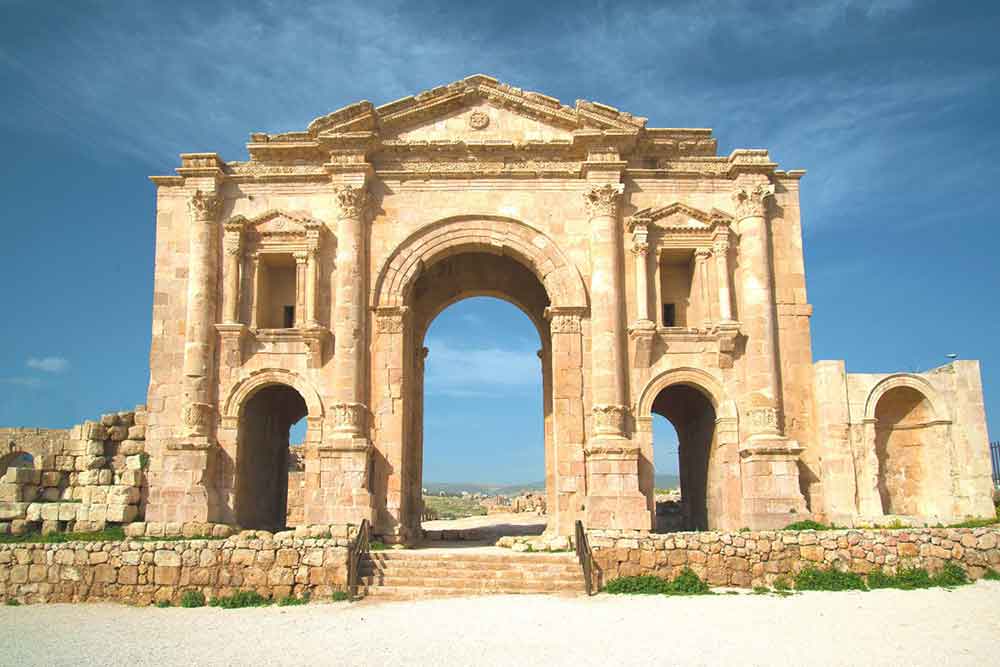
Hadrian’s Arch dates to 129AD and was built to commemorate a visit from Emperor Hadrian. This and the nearby Hippodrome are the first things you’ll see. The Hippodrome hosted chariot racing in front of an audience of 15,000 – they do re-enactments here which can be booked via Jordan Tourism official website.
The Colonnade Forum
Follow the old City walls along to the main archaeological site. Just before you get to the arch and on the right-hand side is the visitor centre. Enter the arch and walk up to the iconic Colonnade Forum.
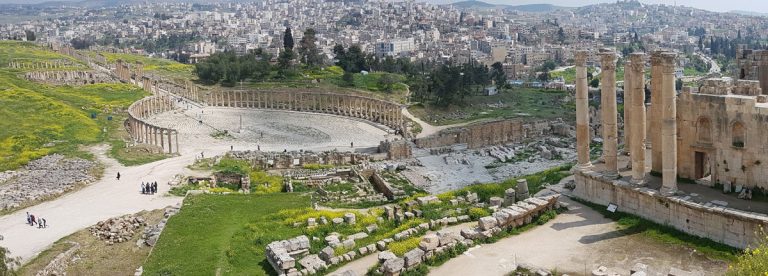
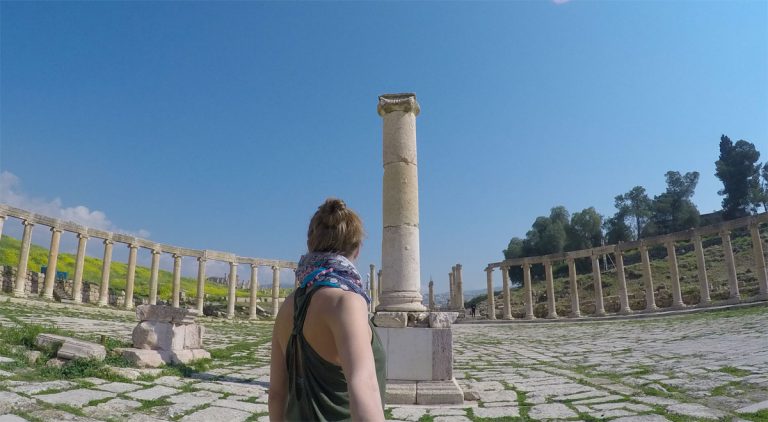
This forum was one of my highlights when I visited the ruins of Jerash as well as being one of the most Iinstagrammable places in Jordan. Here you’ll find 56 columns surrounding the open oval forum. It’s huge, approx 90m x 80m the limestone cobbles link to the Cardo Maximus.
Getting to Jerash early in the day meant I had the place pretty much to myself, later in the day the forum is filled with tour groups. It certainly didn’t have the same feel, as sharing it with hundreds of people.
Insider Tip: Get to Jerash early in the day, especially if you want to enjoy the ruin site before the crowds. It meant I had the place pretty much to myself, later in the day the forum is filled with tour groups. It certainly didn’t have the same feel, as sharing it with hundreds of people.
Cardo Maximus or the Colonnaded Street
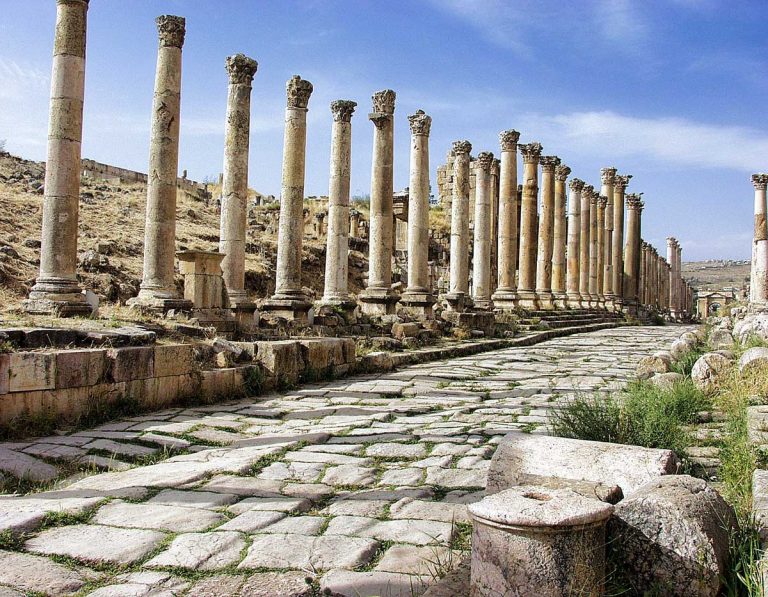
Head out of the Colonnaded Forum and follow the cobbled stones to the Cardo Maximus or the Colonnaded Street.
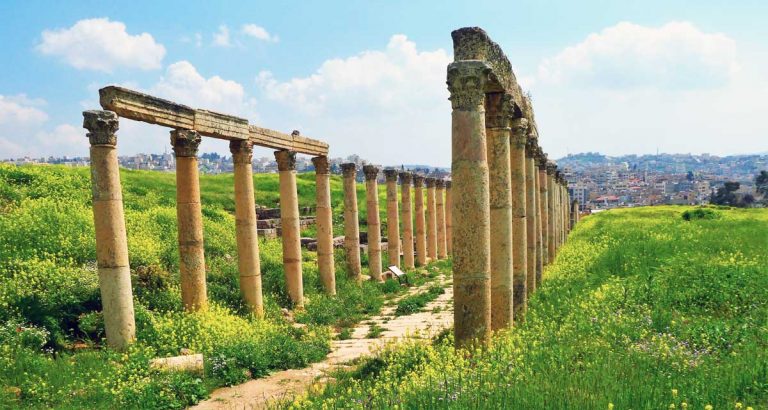
This 800m stretch of road links the North Gate to the Colonnade Forum. It’s still paved with the original stones, so yes it’s uneven but it’s pretty cool to see the wear and tear from the centuries of use – check out the gentle grooves where chariots would once have ridden.
The Nymphean
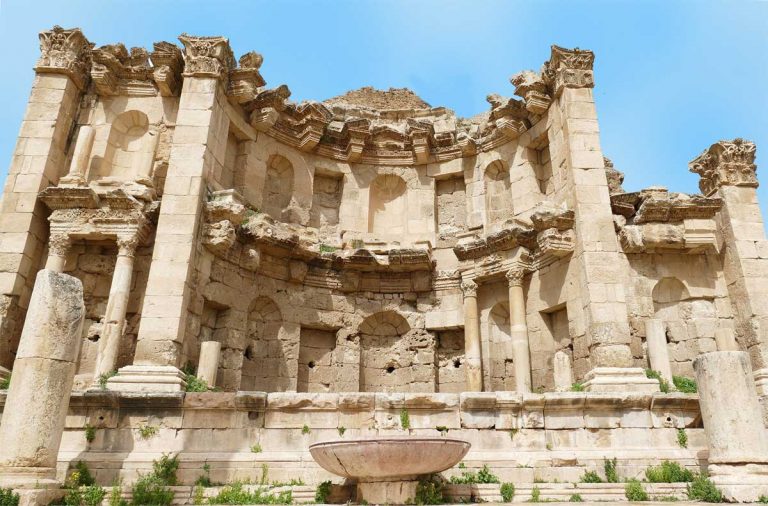
Historically, a Nymphean is where the townsfolk got their water from.
Although there’s not much in terms of water here anymore, you can still make out the foundations of where the fountains and water for the city would have come from. As far as other Jordan ruins of Nympheans go – for example, the ones in Amman and Petra – this is the best preserved of the lot.
This would have been quite something back in Roman times.
The Propylaeum
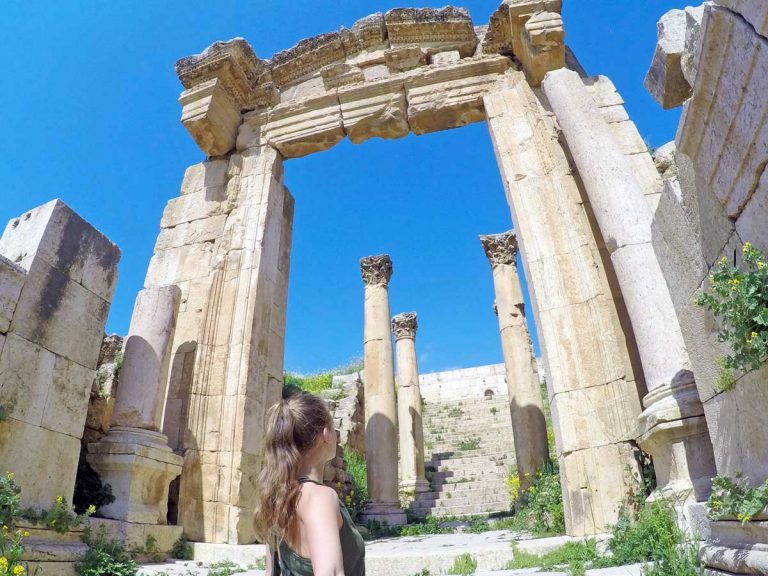
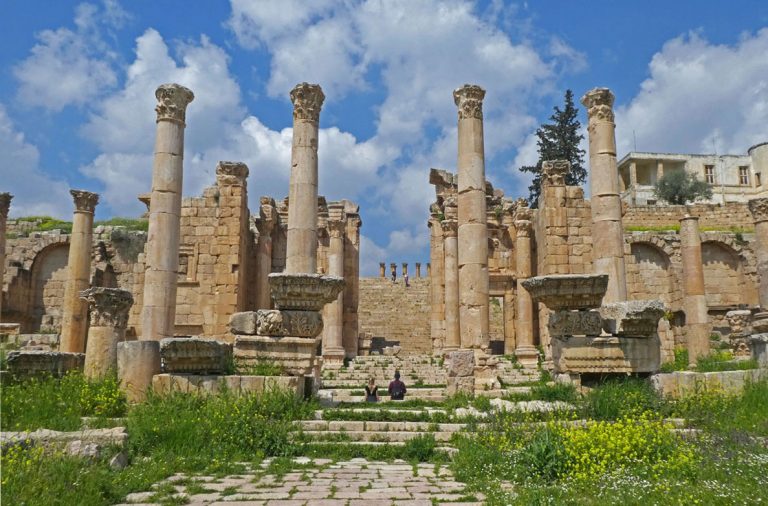
You can’t miss this, the Propylaeum is a massive decorative gateway and staircase leading up to the Temple of Artemis. The size of this Propylaeum defines how important the Temple of Artemis would have been at the time. It’s big!
For an idea of scale – check out the two people at the bottom of the stairs and then compare them to the two little people right at the top of the stairs!
Temple of Artemis
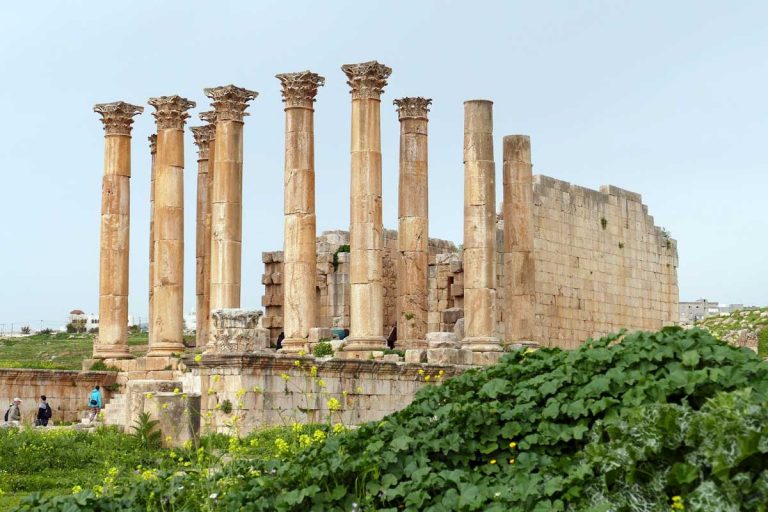
Although what remains doesn’t resemble much of a temple, what stood here in its heyday would have been something impressive! The Temple of Artemis is situated at the top of The Propylaeum and looks down on the ruins of Jerash.
Artemis was the patron goddess of the city, and this temple was dedicated to her. Not much of this impressive temple remains. This is due to its dismantling in subsequent centuries so the stone could be used as building materials from 386AD for new churches.
Related Article: Best Luxury Glamping in Wadi Rum
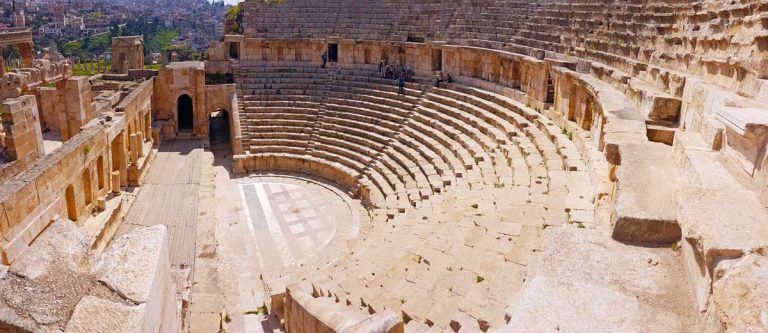
North Theatre
What the North Theatre lacks in size compared to the South Theatre, it certainly makes up for its charm. I actually preferred this theatre with its pretty doorways and coloured tiled floor.
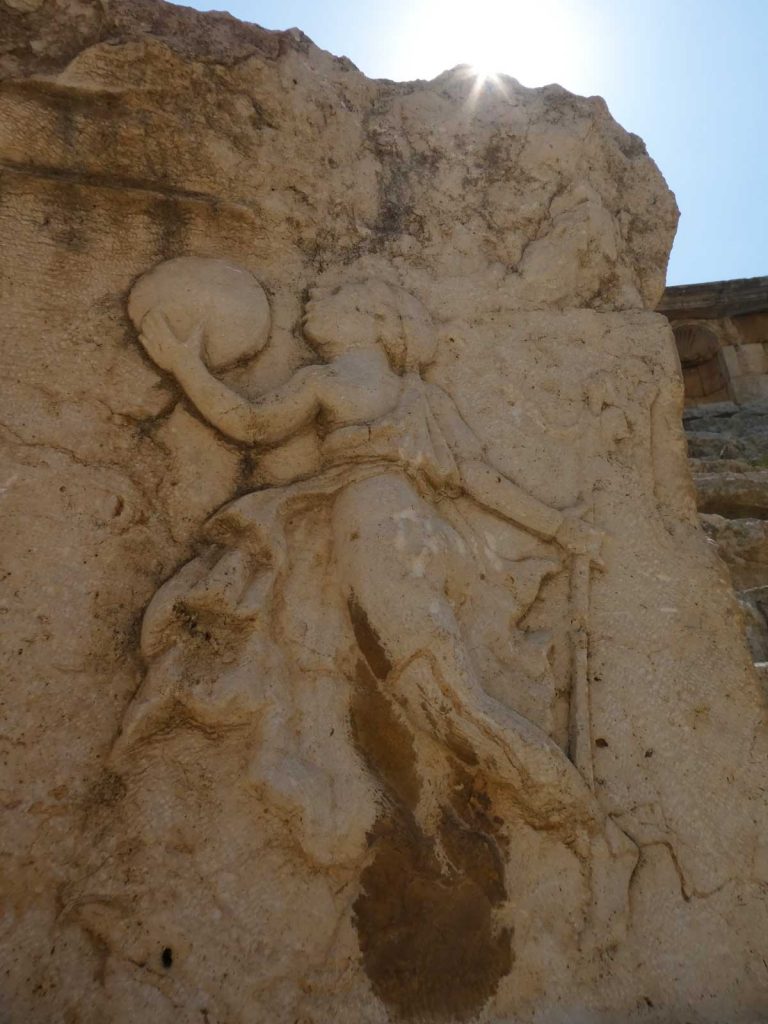
There are also lots of cute carvings on the walls and seating if you look carefully. Originally built in 165AD and fully restored, this was one of my favourite spots in Jerash.
If you like theatres and colosseums, then you’d love the ones in Amman.
Temple of Zeus
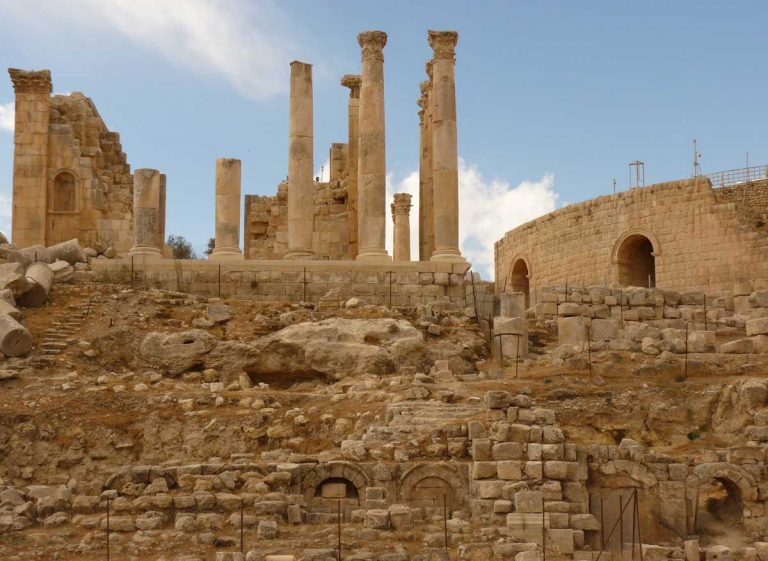
Similarly to the Temple of Artemis, not many remains of this temple (build about 162AD).
The Temple of Zeus suffered the same fate as the Temple of Artemis – building materials for subsequent structures! However, standing on top of this ruin, with its prominent position on the hillside does provide some great lookout points on the city below. Another decent photo spot.
Check Availability: Private Half Day Tour to Jerash from Amman with Transportation
South Theater
Built in the 1st century, restored, and still in use today with seating for 5000 spectators, the South Theatre sits on a hillside looking down over the rest of the archaeological site. It sits next to the Temple of Zeus.
Like with the Temple of Zeus, climbing up to the upper level of the Colosseum you can get some awesome panoramic shots of the archaeological site, particularly of the Colonnaded Forum.
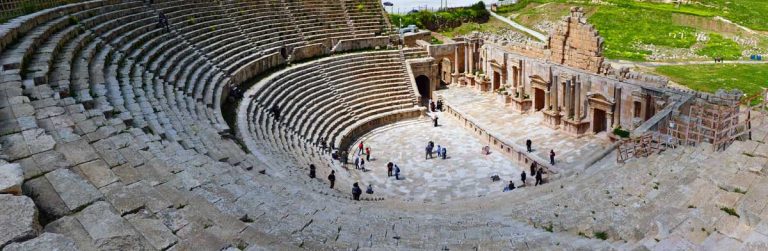
Frequent performers are milling about this area. On the day I visited, a guy was playing the bagpipes and a drummer. I still stand by my argument that on a bagpipe, any tune, in any country of the world sounds exactly the same. It was no different here at the ruins of Jerash.

Vising the Ruins of Jerash, Jordan – FAQ
I’ve given you a ton of detail so far about what to expect when you visit ancient Jerash. This section covers answers to other questions you might have about planning your trip to the Jerash, Jordan Roman ruins.
In Which Country Is the City of Jerash Located?
The city of Jerash is located in Jordan. It is one of the most important and well-preserved ancient Roman cities in the region, making it a popular historical and archaeological site for visitors to explore.
What Is Jerash in Jordan?
Jerash is an ancient city in Jordan, situated approximately 48 kilometres (30 miles) north of Amman. It boasts remarkably well-preserved Greco-Roman ruins, including theatres, temples, and historical structures.
Why Is Jerash Called the Pompeii of the East?
Jerash is often referred to as the “Pompeii of the East” due to its resemblance to the ancient Roman city of Pompeii in Italy. Both cities were once thriving Roman settlements and their remarkably well-preserved ruins showcase similar features, offering valuable insights into the daily life and architecture of the Roman era.
When Is the Best Time to Visit Jerash?
The best time to visit Jerash is during the spring (March to May) and autumn (September to November) seasons. These months offer mild temperatures, making it pleasant to explore the ancient ruins.
Is Jerash Worth Visiting?
Yes, Jerash is definitely worth visiting! The highlights of Jerash include exploring its remarkably well-preserved Roman ruins, such as the theatres, temples, and columns. If you’re wondering what to do in Jerash then I recommend strolling down the ancient streets, watching historical reenactments, and visiting the Jerash Archaeological Museum for a comprehensive insight into this fascinating ancient city’s history.
When Was Jerash Built?
Jerash was founded as a Hellenistic city in the 2nd century BCE. However, there has been a settlement there since prehistoric times.
How Can I Do a Day Trip to Jerash From Amman?
You can do a day trip to Jerash from Amman by various means: take a bus from Amman’s North Bus Station, drive yourself if you have a rental car, hire a taxi for convenience, or join an organized tour for a hassle-free experience.
Check Availability: Private Half Day Tour to Jerash from Amman with Transportation
Where Can I Find a Jerash, Jordan Map?
You will typically receive a map of Jerash, Jordan, upon arrival at the archaeological site. However, you can also find a map of the site on Google Maps, which provides a detailed layout and helps you navigate through the ancient city’s ruins during your visit.
Are You Planning to Visit Jerash, Jordan?
Are you planning to visit Jerash from Amman, Jordan?
As a fanatic of ruin sites, I absolutely loved this site. If you’re visiting Jordan, then I highly recommend taking the opportunity to explore one of the most amazing archaeological sites in the world – the Pompeii of the East!
Planning on travelling around Jordan? Read more inspirational articles…